


I saw two doctors for the same problem: insomnia so total that some nights I didn’t sleep more than an hour, and the anxiety and depression that grew out of that sleeplessness after my child was born. Both doctors wanted to help me in their own way — only one of them believed I could actually get well.
The first opened every appointment with a prayer, and coming from my own faith, that felt meaningful. I walked into those early visits with a small glimmer of hope that this was someone who would see all of me. But over time, the message quietly shifted from “let’s ask God for healing” to “here’s how you learn to live with this.” When I said, more than once, that I wanted a way out instead of another prescription, the conversation moved on without really landing on what I’d said. What I heard, more or less, was that plenty of people live on these medications and I should accept that this was my fate. Each time, that glimmer got a little smaller, until one day I walked out of her dark office with another prescription in hand, down what felt like the coldest, harshest hallway I had ever walked, more hopeless than I had ever been in my life and seeing no way out.
The second doctor offered almost no warmth at all. There was no prayer, no small talk, just a clipped efficiency that put me off the first time we met. But she was the one who looked at me and asked, “Do you want to get off of these? I can help you.” Something in me shifted the moment she said it. For the first time, a doctor had heard what I’d been asking for, and I felt a small spark I hadn’t felt in a long time, like a fog starting to lift before anything else had even changed. She ordered bloodwork that confirmed Hashimoto’s, which was likely feeding into everything else alongside my anxiety over my daughter’s health, and the depression that came with so little sleep. She prescribed targeted supplements based on what those labs showed, guided me off the medications one careful, supervised step at a time, and was the first doctor to tell me the Autoimmune Protocol could actually help. She believed, plainly and unsentimentally, that I could heal, and then she handed me an actual path to prove it.
I’ve turned that contrast over for years, and I suspect a lot of people reading this have sat across from both kinds of practitioners. Maybe you know that first feeling too, the one where you leave an appointment smaller than when you walked in. My faith is central to who I am, and so is my respect for good medicine. Those prescriptions may have helped me get through some of the very worst nights, but long before I met the second doctor, I could feel they weren’t carrying me toward the kind of healing I wanted. What mattered in the end wasn’t whether either doctor opened with a prayer or reached for a prescription pad. It was whether she truly believed I could get well, and whether she was listening closely enough to hear me when I answered that for myself.
What mattered in the end wasn’t whether either doctor opened with a prayer or reached for a prescription pad. It was whether she truly believed I could get well.

What Your Mind Does to Your Body
I’d believed in the power of the mind since I wrote my college entrance personal essay, built around what I called the law of focus: whatever you focus on grows in your mind. What I hadn’t yet understood was that the same law applied to healing itself, not just ambition or attention. I only found that out by living it, and years later, reading the science, I recognized exactly what I’d lived through. The science turned out to be far more specific than the believe-hard-enough version of that idea.
Lissa Rankin, MD arrived at the same realization from the other side of the exam table, seeing it in her patients instead of living it herself. In her book Mind Over Medicine, she describes going back to patients who were doing everything medically right — clean diets, regular exercise, every supplement recommended — and still getting sicker. When she asked them directly what they believed was standing in the way of their healing, the answer was almost never about food or exercise. It was a marriage that was quietly destroying them, or a job they dreaded every morning, or a wound from childhood they had never really dealt with. The parts of health that traditional medicine rarely asks about turned out to be running the whole show underneath. (Rankin, 2013)
Dr. Jeffrey Rediger, a Harvard psychiatrist, spent fifteen years chasing another version of this question. In his book Cured, he investigates documented cases of people who recovered from illnesses that should have killed them: stage four cancers, tumors given single-digit survival odds, diagnoses doctors had already called terminal. The patients he studied paired their medical care with real changes in diet, relationships, and belief about their own recovery, and many are still alive more than a decade later, with no trace of the disease that was supposed to end their lives. Rediger treats it as a pattern worth studying rather than magic, and his patients kept their treatment while taking belief, community, and root cause just as seriously. Being honored in what I actually wanted, and cared for by someone who clearly knew what she was doing, was exactly what I found in my second doctor, and exactly what was missing from my first. (Rediger, 2020)
On exercise: The placebo effect, studied for over fifty years, shows that what you expect a treatment to do changes what it does; and its quieter twin, the nocebo effect, shows the reverse. Harvard researchers Dr. Alia Crum and Dr. Ellen Langer put a sharper point on this in a 2007 study of 84 female hotel housekeepers across seven hotels. Housekeepers at four of the hotels were told, accurately, that their daily work of cleaning rooms already met the Surgeon General’s guidelines for an active lifestyle. Housekeepers at the other three hotels were told nothing. Four weeks later, the informed group showed measurable drops in weight, blood pressure, body fat, and waist-to-hip ratio compared to the control group. They didn’t work any harder or change a single habit. The only thing that changed was how they understood the work they were already doing, and their bodies responded as if that understanding were the treatment (Crum & Langer, 2007).
On stopping treatment: Expectation even shapes what it feels like to come off a medication. When researchers pooled 79 studies of people discontinuing antidepressants, about 31 percent reported discontinuation symptoms, and so did 17 percent of people who stopped taking a placebo, a pill with nothing in it to withdraw from (Henssler et al., 2024). Withdrawal is real and needs careful supervision, but part of what people feel when they stop is shaped by what they’ve been told to expect.
On hunger: Dr. Crum ran an even more precise version of this same idea a few years later, this time with milkshakes instead of housekeeping. Forty-six participants drank the exact same 380-calorie shake on two separate occasions, once believing it was a 620-calorie “indulgent” treat, and once believing it was a 140-calorie “sensible” one. When they believed it was the indulgent shake, their ghrelin, the hormone that signals hunger, dropped sharply afterward, the body’s normal signal of being fed. When they believed the identical shake was the sensible version, ghrelin barely moved, as though the body hadn’t registered being fed at all. It was the same shake, the same calories, and the same person both times, but a hunger hormone that responded to the label instead of the liquid (Crum et al., 2011).
On food choices: The same lab later took this idea into a university dining hall. Over one fall quarter, vegetables were labeled four different ways: plainly (“carrots”), in restrictive health terms (“light ’n’ low-carb”), in positive health terms (“high-antioxidant”), or indulgently (“twisted citrus-glazed carrots”). With the indulgent names, 25 percent more diners chose the vegetables than with the plain labels and 41 percent more than with the restrictive ones, and they ate more of them too. This one hits close to home, since so much of my nutrition work happens in kitchens and workshops where a lot of people walk in already believing healthy food has to taste like a sacrifice. The words a practitioner uses for food carry a mindset along with them, and that mindset shapes what people choose and, as the milkshake study showed, how their bodies respond (Turnwald et al., 2017).
On genetic risk: Her lab pushed this even further in a study on genetic risk. Participants were genotyped for their actual risk of obesity, then randomly told they’d tested as high-risk or as protected, regardless of what their DNA said. The false information alone changed real physiology, cardiorespiratory fitness, how hard exercise felt, and how long people could run. A second version of the study found the same pattern with satiety: people’s sense of fullness and the physiology behind it shifted based on which result they believed, not which one was true. In some cases, the effect of believing you were at risk turned out to be larger than the effect of actually being at risk. It makes me wonder what we’ve each been told about our own bodies, a label or a prognosis or a family story, that our bodies may have simply believed (Turnwald et al., 2019).
On stress: Dr. Alia Crum, now a Stanford psychologist, has also spent years studying how the mindset we bring to stress changes what stress does to the body. Her research shows that people who view stress as something that can sharpen focus and performance, rather than something purely damaging, have a different physiological stress response than people who see it as only harmful. In this framework, stress itself isn’t the enemy; a person’s relationship to it determines whether it wears them down or moves them forward. It’s the piece of Crum’s work I’ve shared most often, including when I spoke at the AIP Summit, because almost everyone has a relationship with stress they’ve never stopped to question (Crum et al., 2013).
On inflammation: In 2025, Crum’s lab tested whether that same kind of reframe could change how people processed the pandemic as a catastrophic life event. Participants who watched short videos suggesting that catastrophic experiences can also become sources of growth were compared, three months later, to participants who had watched purely informational content instead. The group exposed to the growth-oriented framing showed lower depression scores and lower levels of C-reactive protein, a marker of inflammation in the blood. A shift in how people made sense of a hard season showed up later in their bloodwork, not just in how they described their mood (Barrera et al., 2025).
Underneath all of it sits Dr. Carol Dweck’s research on the growth mindset, the finding that people who believe they can learn, adapt, and change show more resilience and better outcomes when facing a challenge than people who believe their circumstances are fixed. That belief about the self turns out to be foundational to almost everything else on this list, including how willing someone is to keep trying once the first attempt doesn’t work (Dweck, 2006).
It was the same shake, the same calories, and the same person both times, but a hunger hormone that responded to the label instead of the liquid.
The Practitioner Is Not a Neutral Instrument
Most people who go into healing work, whether that’s medicine, coaching, nutrition, or ministry, start from the same place: a genuine wish to help. That impulse is real, and it matters. What the research adds is a reason to believe that impulse can do more than most of us were ever trained to expect, because a practitioner’s own belief turns out to be part of the treatment itself, not a professional courtesy layered on top of it.
A survey of 84 nurses and 49 physicians found that 71.2 percent of them had deliberately tried to shape a patient’s expectations within the past year to strengthen the effect of an active treatment, and the two tools they reached for most often were optimism and empathy. This is ordinary clinical behavior, happening constantly, often without formal training and sometimes without full awareness of what was being done (Vambheim et al., 2022).
The biology underneath this has a name, psychoneuroimmunology, but clinical training rarely treats the practitioner’s side of it as a skill worth building on purpose, and the payment system reimburses a rushed visit no differently than an attentive one.
I grew up watching one of the rare exceptions. My father, Dr. Nagui Saleh, a retired physician, spent about ten years as the physician champion at his center for an initiative run by the large healthcare system where he practiced in the DC area and surrounding states. It was called PRIMO, short for Patient Relationships Improve Medical Outcomes, and the name alone makes the case this essay is trying to make. Once a month, champions like him gathered in a hotel or rented hall for training, practicing with simulated patients, and then he brought what he’d learned back to the twelve to fourteen doctors he was responsible for. He also read through randomly selected patient surveys, the ones that came back online or by letter, to see how those visits had landed with the people in them.
What they practiced was the Four Habits Model, a framework developed by physician Terry Stein and communication researcher Richard Frankel: invest in the beginning of the visit, elicit the patient’s perspective, demonstrate empathy, and invest in the end. When I read that second habit now, I think of my second doctor, whose whole turning point with me was a question about what I wanted. I also think of my dad, who taught this to other doctors and lived it with his own patients, long before I understood why it mattered. The program has since dissolved. My dad thinks it came down to cost: pulling a dozen or more doctors away from their patient schedules once a month adds up quickly, and I’d guess the benefits were a lot harder to put on a spreadsheet, which is its own lesson for anyone trying to build something like it now. For ten years, though, he was one of the people making sure doctors learned how to make a patient feel heard. I look up to him for a lot of reasons, and that’s one of the biggest (Frankel & Stein, 2001).
Crum’s lab has since built a version of that curriculum and tested it formally. A training called Medicine Plus Mindset, led by Dr. Kari Leibowitz, went into five primary care clinics in the Bay Area and trained everyone, not just the doctors, but front desk staff and medical assistants too, on four things: how patients think about their treatment, their body, their illness, and whether their care team gets it and gets them. Afterward, job satisfaction among the 186 participating clinicians and staff rose by about 11 percent, and staff reported using what they’d learned when they talked with patients.
Leibowitz and her colleagues are upfront that they measured staff experience rather than patient outcomes, and they flag the patient side as still unmeasured, which is the exact gap this essay sits inside. Working on both mindsets deliberately and at the same time, the practitioner’s and the patient’s, still seems like wide-open territory (Leibowitz et al., 2024).
On immunity: A randomized trial out of the University of Wisconsin, involving 719 patients with a new cold, put a number on what warmth and empathy can do. Researchers split patients into three groups: no visit with a practitioner, a standard visit, and a visit where the physician deliberately practiced warmth and empathy. Patients in the warmth-and-empathy group reported shorter, less severe colds, and researchers also measured an immune marker called interleukin-8 in their nasal secretions and found it had shifted too. The practitioner’s demeanor in the room changed the patient’s immune response, not just how the patient described feeling about being sick (Rakel et al., 2011).
On warmth and competence: Stanford’s Mind and Body Lab tested this directly. In one experiment, 159 people got a histamine skin prick, the kind used in allergy testing, and a provider then rubbed an ordinary, unscented lotion on the spot, telling some participants it would ease the reaction and others that it would make it worse. The researchers also varied how the provider came across: warm or cold, competent or unsure. When the provider was both warm and competent, the expectation showed up on people’s skin, and reactions were smaller in the people told the lotion would help. When the provider was cold and seemed unsure of what they were doing, the same words made no measurable difference at all. The expectation only took hold in the body when it came from someone the patient felt understood both the problem and them (Howe et al., 2017; Howe et al., 2019).
What Warmth Is Made Of
None of this is mysterious once you look at the pathway underneath it. A perceived threat, real or imagined, gets processed through the amygdala and the hypothalamus, which activates the HPA axis and floods the body with cortisol and adrenaline. That response serves us well against real danger, but it turns destructive when it runs constantly, since chronically elevated cortisol suppresses the immune signaling the body needs to repair tissue and fight infection. A sense of safety and hope engages the opposite pathway, calming the nervous system through the vagus nerve and allowing inflammatory markers to come back down, the same interleukin-8 that shifted in the cold study above, the same C-reactive protein that dropped in Crum’s 2025 trial. That’s why a private, intangible belief keeps turning up later as something measurable in a blood test.
That’s the language for what happened in those two exam rooms, though my own story pushes on it a little. My first doctor had the outward signs of warmth, the prayer and the kindness, and none of it landed the way she meant it to, because she wasn’t hearing what I was asking for. Her belief about what was possible for me had also settled into something fixed. My second doctor had almost none of those outward signs, but she paired real competence with a question about what I wanted, and when I answered it, she heard me. It makes me wonder whether part of what patients experience as warmth is the feeling of being asked what they want. Crum and a pediatrician colleague, Barry Zuckerman, once described two mindsets a clinician shapes in every visit: one about whether the treatment will work, and one about whether the patient is capable of change (Crum & Zuckerman, 2017). Looking back, my second doctor built up both in a single sentence. My first doctor, without ever meaning to, had been quietly wearing down both.
There’s a whole clinical approach built around that kind of asking. Motivational interviewing, developed by psychologists William Miller and Stephen Rollnick, trains practitioners to draw out a person’s own reasons for changing instead of handing them reasons from the outside. A review of 48 randomized trials in medical settings found it helped with outcomes ranging from blood pressure and cholesterol to body weight and quality of life, even when it was delivered in brief visits (Lundahl et al., 2013).
What caught my attention is where that benefit seems to come from. When researchers pooled 36 studies to look inside these sessions, the practitioner’s skill at drawing out the client’s own talk about change was strongly linked to clients talking about change themselves, and that talk was in turn linked to reductions in risky behavior later, while empathy and warmth on their own didn’t show that same link (Magill et al., 2018). The effects are modest, and the histamine study is a reminder that warmth still matters. A meta-analysis of 184 data sets from health settings points the same way: when practitioners supported patients’ autonomy, patients experienced their motivation as their own, and that was tied to better outcomes, from lower depression and anxiety to quitting smoking and sticking with medication (Ng et al., 2012). What the pattern suggests is that warmth may do its best work when it comes with a real invitation for the person to say what they want. My second doctor did all of that with one question. I’d love to see someone study all three together in the exam room: warmth, competence, and simply asking the patient what they want. I’d especially love to see it studied in the moments when someone is asking for a change in their treatment plan.
Warmth may do its best work when it comes with a real invitation for the person to say what they want.
None of this is a claim that belief alone cures every illness, and it would be a painful misreading of the evidence to walk away thinking so. The people whose stories fill books like Cured survived to tell them. We don’t hear as often from the many who changed their beliefs just as sincerely and still died. Mindset is a real, measurable lever on healing, not a guarantee, and any practitioner who implies otherwise, even gently, risks handing a sick person a second burden on top of their illness: the quiet suggestion that if they don’t get better, it’s because they didn’t believe hard enough. That’s not what the research actually shows, and it’s not what I want anyone reading this to take from it. If you’re reading this from the middle of an illness that hasn’t budged, none of this is a verdict on you.
The Question Underneath the Question

In the Gospel of John, Jesus of Nazareth comes across a man at the pool of Bethesda who has been sick for thirty-eight years, and he asks him something almost strange: do you want to be made well? (John 5:2–6) The first time I really sat with that question, I thought of my second doctor. She had asked me almost the same thing.
It seems like an odd question to put to someone who has clearly been suffering for decades, someone with every apparent reason to want relief. He was also parked by a pool that many around him believed held power for miraculous healing. The man doesn’t say yes. He explains his circumstances instead, telling Jesus that he has no one to help him into the water when it stirs. Jesus heals him anyway, but the question does its own work first. It asks the man to take ownership of his own wanting rather than assuming the answer is obvious.
Jesus doesn’t stop at the question, either. The very next instruction is surprisingly physical: rise, take up your bed, and walk. He doesn’t tell the man to rest a while longer to be sure it worked, or to wait for someone else to confirm it. The mat he’d spent thirty-eight years lying on becomes the thing he carries himself, still in his own hands, just no longer in control of him. Belief that stays only in the mind isn’t what heals him here; it’s belief paired with the walking, the plain physical mechanics of getting up and moving before he’s even had time to process what had just happened (John 5:8–9).
It’s also worth noticing what day this happened on. Healing him, and then telling him to carry his mat, went against the way Sabbath law was interpreted at the time. The commandment itself was about resting from work, but the religious tradition around it had grown into a long list of restrictions, and carrying a mat counted as breaking it. The leaders who confront the healed man afterward were holding to that commonly accepted reading. Jesus goes against it anyway. He saw the law as being in the service of God and people, or as he puts it elsewhere, “The sabbath was made for man, and not man for the sabbath.” In that moment, the man in front of him mattered more than the conventional interpretation, and more than the expected response would have allowed. That’s not so different from what separated my two doctors. One offered the familiar, comfortable script. The other went beyond the standard playbook most doctors default to, and that’s exactly where the healing happened (John 5:9–10; Mark 2:27).
I think all three of these — the question, the action, and the cost — belong to the practitioner just as much as they belong to the client. Do you want to be made well, in your own beliefs about what’s possible, in your own relationship to stress and fear and the fixed stories you carry about yourself? And are you willing to get up and walk, even when that means stepping outside the comfortable, expected script? It’s tempting for anyone in a caregiving role to assume these questions only point outward, toward the person they’re helping, but nobody is exempt from having to answer them honestly, including the one doing the helping.
Stephen Trzeciak MD | Doctor T, a critical care physician and co-author of Compassionomics, is making a strikingly similar case right now, from an ICU instead of a first-century pool. He writes about the science of hope in his newsletter, The Hope Effect, and works from a definition, borrowed from researcher Chan Hellman, that fits neatly alongside the Bethesda story: hope is the belief that the future will be better than the present, and that we play a vital role in making it happen. Belief plus action, arrived at from a completely different direction, landing in almost the same place as a man told to pick up his mat and walk (Trzeciak, 2026).
A Simple Way to Check
When I sit with this question, either for myself or alongside someone I’m working with, I break it into four smaller ones. I call it WELL: Witness it, check the Effect, Lend it, Let go.
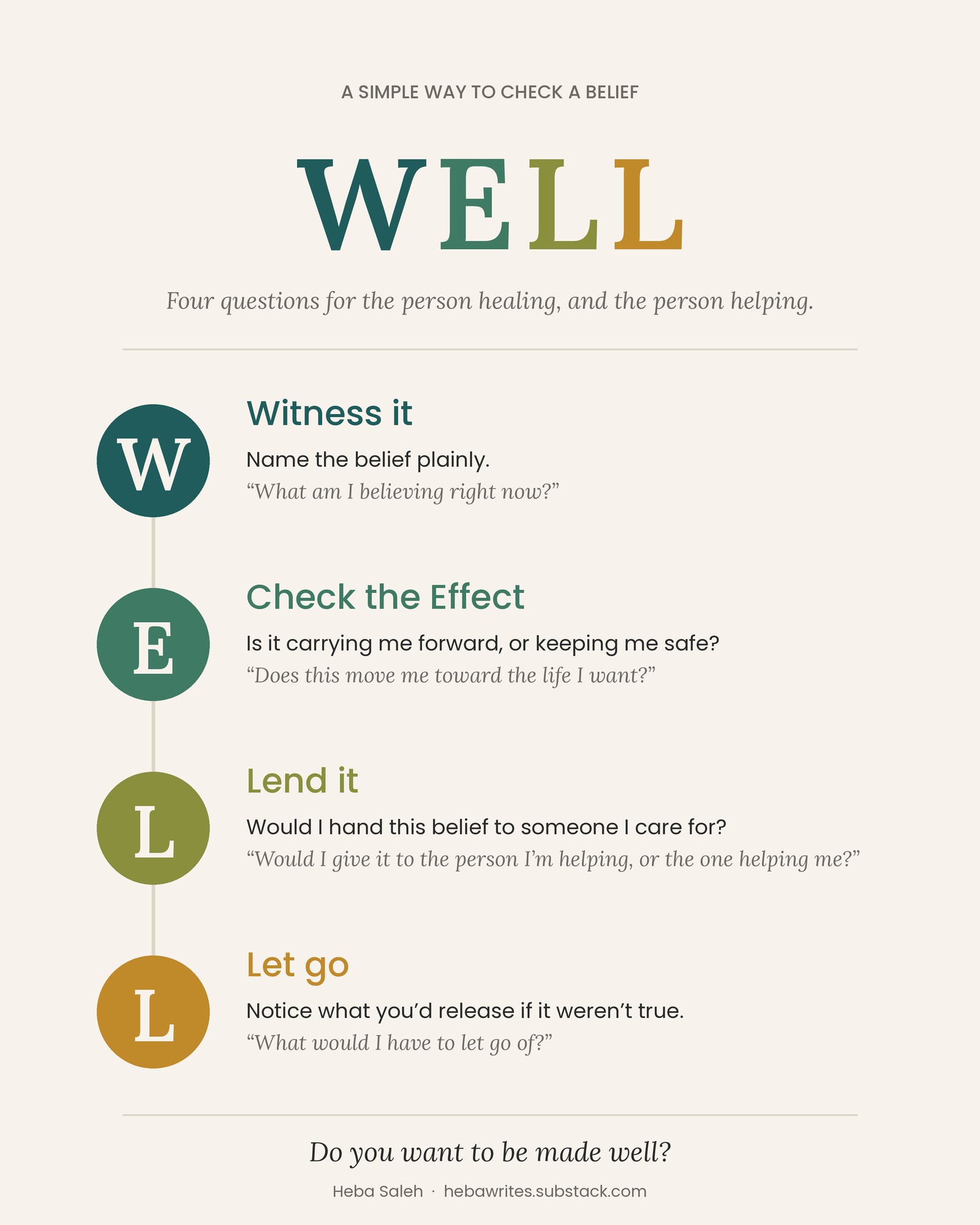
Witness it first, by naming plainly, without softening it, the belief you’re operating from. Then check its effect: does this belief carry you toward the life you want, or does it just keep you safe from the risk of trying something and being disappointed? Third, lend it: would you hand this exact belief to the person you’re caring for, or to the one caring for you? If the honest answer is no, that tells you something about how much weight the belief deserves. Finally, let it go: notice what you’d have to release if this belief turned out to be untrue.
If you’re the one holding space for someone else’s healing, the same four questions work on you too, just aimed at a different belief. Maybe it’s a quiet certainty that a particular client won’t really follow through, or a ceiling you’ve unconsciously set on what’s possible for someone based on where they started. Witness that belief plainly instead of letting it run as background noise. Check whether it’s protecting them or protecting you from the discomfort of getting invested in someone who might not change. Ask whether you’d want them to know that they were being quietly measured against it. Then notice what you’d have to let go of to walk into the next session without it already sitting in the room. Those last two steps are where WELL overlaps most with motivational interviewing. Lending the belief makes you look at it from the other person’s side, and letting it go clears space for them to tell you what they want instead of you deciding it for them ahead of time, which, as far as I can tell, is most of what motivational interviewing is trying to protect. If you want somewhere to start, try asking some version of her question in your next session before you offer anything else: what do you want?
Wherever You’re Sitting
A practitioner doesn’t have to be fully healed before she’s allowed to help anyone else; that standard would empty every clinic, every studio, and every counseling room in the country. Healing simply isn’t as one-directional as the story we usually tell about it. The client is doing the work of believing she can get better, and the practitioner is doing that same work too, whether she calls it that or not, every time she walks into a room and decides what she believes is possible for the person in front of her.
I want to be careful here, because many medications, especially the kind that touch mood and sleep, should never be stopped without a doctor’s supervision, and withdrawal itself can be dangerous. That’s exactly why a doctor’s belief and willingness to partner in that process matters as much as it does. Without it, a person can stay on something indefinitely, never finding out safely whether they still need it at all.
With my doctor’s supervision, I eventually didn’t need them anymore. The fog that started to lift in her office didn’t clear all at once, but it did clear. My labs changed, but so did the belief underneath them, and so did the decision to take the helm of my own healing instead of waiting for someone else to hand it to me. These days I still have some challenging weeks, and life hasn’t become frictionless just because I know better now. I’ve come to expect that challenge is part of how growth works, not proof that something has gone wrong, though I’ll admit I still pray for a lighter load now and then.
I think about those two doctors often now, especially in the moments when someone sits down across from me and hands me their trust along with their story. Whatever tools I bring to that chair, from mindset to nutrition to movement, what matters most is deciding every single time whether I’m going to offer someone a fixed story about themselves or a growing one, and whether I’m actually going to listen when they tell me what they want instead of what I’ve already assumed on their behalf. That’s the inheritance I took from the second doctor, more than any protocol she gave me: belief, paired with attention.
These days I sit in that chair in more than one way. I’m in the clinical part of my Nutritional Therapy Practitioner training now, working with case study clients, which means I’m practicing all of this in a health setting in real time, deciding in every session what I believe is possible for the person in front of me. And for the past year I’ve volunteered as a peer mentor with Postpartum Support International, talking with mothers who are in the same season I once got lost in. I know what it can mean to hear someone say there is a way through and actually mean it. When I sit with them, I try to remember that hallway, and the question that finally got me out of it.
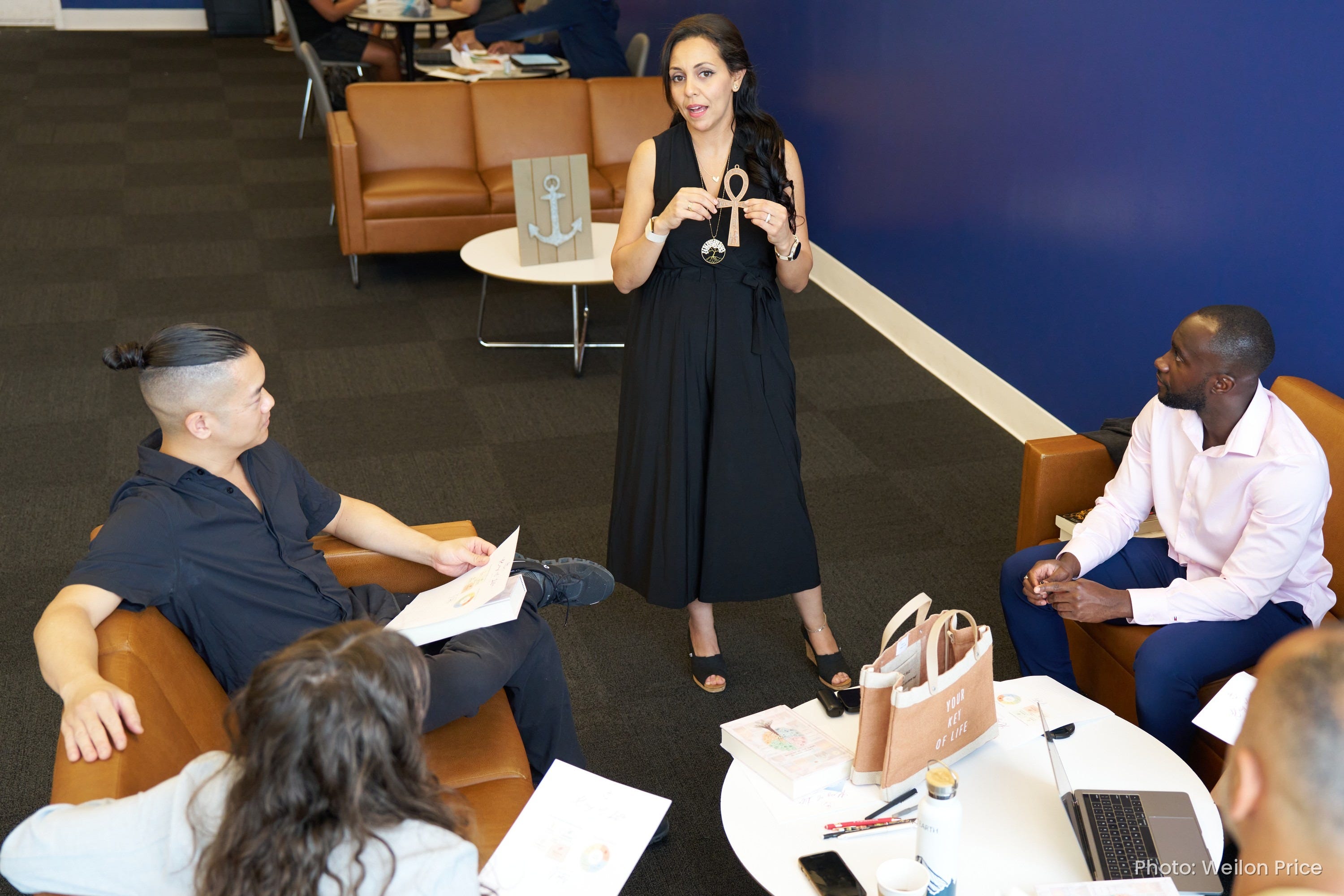
It’s also why I started Key of Life and built Mindset Groups the way I did. I felt that accountability, the steady kind that keeps showing up for you, was missing for so many people, and I think we often end up building what we needed most ourselves. If there’s a key of life for me, it’s that: offering people hope, and helping them see they’re capable of so much more than they think once they have the right support. Every member journals daily in Eight Moments, a mindset journal I published, and checks in with an accountability partner that I pair them with about the one thing they’ll do that day to move a goal forward, and I do my own mindset work right alongside them. It’s a small setting, and I’d never call what I see there data, but it’s the closest thing I have to watching both sides of this essay happen at once: the person being guided and the person guiding, each deciding what they believe is possible.
Most of us didn’t enter this work for the paperwork or the continuing education hours. We entered it because some part of us wanted to help people get their lives back, and it turns out that wish, taken seriously enough to examine our own beliefs alongside theirs, is a stronger tool than most of us were ever taught to use.
Do you want to be made well? Whichever chair you’re sitting in, taking the helm of your own healing starts the same way: by answering that question, out loud, and meaning it.
If this resonated with you, I would love to know. Have you ever had a doctor or practitioner whose belief in you changed something? Or have you been the practitioner who realized your own beliefs were sitting in the room with your client? I would love to hear your story in the comments.
P.S. If you’d like to work on this alongside other people, Mindset Groups is my small-group accountability program through Key of Life, where members practice this kind of mindset work together over a season. You can find when the next cohort starts at yourkeyoflife.com. And if you’re looking for one-on-one support, Healthstarter is where I bring this same mindset-led approach to health coaching. If you’re a researcher or an organization exploring how practitioner and client mindsets work together, I would love to hear from you.
This essay reflects my own experience and the research I found compelling, along with my work as a mindset coach. It isn’t medical advice. Please don’t change, start, or stop any medication or treatment without the guidance of your own physician or qualified healthcare provider.
Heba Saleh is the founder of Key of Life Ventures, a mindset and wellness brand rooted in the belief that growth becomes sustainable when we honor our values, nurture our communities, simplify what supports us, and release what no longer serves us. She leads Mindset Groups, wrote the Eight Moments mindset journal, and volunteers as a peer mentor with Postpartum Support International. An AIP Certified Coach, Certified Culinary Nutrition Expert, NASM-CPT, and RYT-500 yoga instructor with a Master’s in Cultural Studies, she is currently completing her Nutritional Therapy Practitioner certification, teaches yoga across the DC area, and writes about mindset, wellness, and integrated living.
Sources
Rankin, Lissa. Mind Over Medicine: Scientific Proof That You Can Heal Yourself. Hay House, 2013.
Rediger, Jeffrey. Cured: The Life-Changing Science of Spontaneous Healing. Flatiron Books, 2020.
Crum, Alia J., and Ellen J. Langer. “Mind-Set Matters: Exercise and the Placebo Effect.” Psychological Science 18, no. 2 (2007): 165-171. https://journals.sagepub.com/doi/10.1111/j.1467-9280.2007.01867.x
Henssler, J., Y. Schmidt, U. Schmidt, G. Schwarzer, T. Bschor, and C. Baethge. “Incidence of Antidepressant Discontinuation Symptoms: A Systematic Review and Meta-Analysis.” The Lancet Psychiatry 11, no. 7 (2024): 526-535. https://doi.org/10.1016/S2215-0366(24)00133-0
Crum, Alia J., William R. Corbin, Kelly D. Brownell, and Peter Salovey. “Mind Over Milkshakes: Mindsets, Not Just Nutrients, Determine Ghrelin Response.” Health Psychology 30, no. 4 (2011): 424-429. https://doi.org/10.1037/a0023467
Turnwald, Bradley P., Danielle Z. Boles, and Alia J. Crum. “Association Between Indulgent Descriptions and Vegetable Consumption: Twisted Carrots and Dynamite Beets.” JAMA Internal Medicine 177, no. 8 (2017): 1216-1218. https://doi.org/10.1001/jamainternmed.2017.1637
Turnwald, Bradley P., J. Parker Goyer, Danielle Z. Boles, Amy Silder, Scott L. Delp, and Alia J. Crum. “Learning One’s Genetic Risk Changes Physiology Independent of Actual Genetic Risk.” Nature Human Behaviour 3 (2019): 48-56. https://doi.org/10.1038/s41562-018-0483-4
Crum, Alia J., Peter Salovey, and Shawn Achor. “Rethinking Stress: The Role of Mindsets in Determining the Stress Response.” Journal of Personality and Social Psychology 104, no. 4 (2013): 716-733. https://doi.org/10.1037/a0031201
Barrera, Jesse A., et al. “Can Catastrophes Be Opportunities? A Randomized Clinical Trial Testing a Brief Mindset Intervention for Reducing Inflammation and Depression Following COVID-19.” Brain, Behavior, and Immunity 129 (2025): 1028-1038. https://doi.org/10.1016/j.bbi.2025.07.011
Dweck, Carol S. Mindset: The New Psychology of Success. Random House, 2006.
Vambheim, S., M. Bystad, J. Kirkøen, P. Aslaksen, and R. Wynn. “Doctors’ and Nurses’ Use of Expectancy Effects in Clinical Practice.” European Psychiatry 65, no. S1 (2022): S687. https://doi.org/10.1192/j.eurpsy.2022.1769
Frankel, Richard M., and Terry Stein. “Getting the Most out of the Clinical Encounter: The Four Habits Model.” Journal of Medical Practice Management 16, no. 4 (2001): 184-191. https://pubmed.ncbi.nlm.nih.gov/11317576/
Leibowitz, Kari A., Lauren C. Howe, Marcy Winget, Cati Brown-Johnson, Nadia Safaeinili, Jonathan G. Shaw, Deepa Thakor, Lawrence Kwan, Megan Mahoney, and Alia J. Crum. “Medicine Plus Mindset: A Mixed-Methods Evaluation of a Novel Mindset-Focused Training for Primary Care Teams.” Patient Education and Counseling 122 (2024): 108130. https://doi.org/10.1016/j.pec.2023.108130
Rakel, David, Bruce Barrett, Zhengjun Zhang, Theresa Hoeft, Betty Chewning, Lucille Marchand, and Jo Scheder. “Perception of Empathy in the Therapeutic Encounter: Effects on the Common Cold.” Patient Education and Counseling 85, no. 3 (2011): 390-397. https://pmc.ncbi.nlm.nih.gov/articles/PMC3107395/
Howe, Lauren C., J. Parker Goyer, and Alia J. Crum. “Harnessing the Placebo Effect: Exploring the Influence of Physician Characteristics on Placebo Response.” Health Psychology 36, no. 11 (2017): 1074-1082. https://doi.org/10.1037/hea0000499
Howe, Lauren C., Kari A. Leibowitz, and Alia J. Crum. “When Your Doctor ‘Gets It’ and ‘Gets You’: The Critical Role of Competence and Warmth in the Patient-Provider Interaction.” Frontiers in Psychiatry 10 (2019): 475. https://doi.org/10.3389/fpsyt.2019.00475
Crum, Alia, and Barry Zuckerman. “Changing Mindsets to Enhance Treatment Effectiveness.” JAMA 317, no. 20 (2017): 2063-2064. https://pubmed.ncbi.nlm.nih.gov/28418538/
Lundahl, Brad, Teena Moleni, Brian L. Burke, Robert Butters, Derrik Tollefson, Christopher Butler, and Stephen Rollnick. “Motivational Interviewing in Medical Care Settings: A Systematic Review and Meta-Analysis of Randomized Controlled Trials.” Patient Education and Counseling 93, no. 2 (2013): 157-168. https://pubmed.ncbi.nlm.nih.gov/24001658/
Magill, Molly, Timothy R. Apodaca, Brian Borsari, Jacques Gaume, Ariel Hoadley, Rebecca E. F. Gordon, J. Scott Tonigan, and Theresa Moyers. “A Meta-Analysis of Motivational Interviewing Process: Technical, Relational, and Conditional Process Models of Change.” Journal of Consulting and Clinical Psychology 86, no. 2 (2018): 140-157. https://doi.org/10.1037/ccp0000250
Ng, Johan Y. Y., Nikos Ntoumanis, Cecilie Thøgersen-Ntoumani, Edward L. Deci, Richard M. Ryan, Joan L. Duda, and Geoffrey C. Williams. “Self-Determination Theory Applied to Health Contexts: A Meta-Analysis.” Perspectives on Psychological Science 7, no. 4 (2012): 325-340. https://doi.org/10.1177/1745691612447309
Trzeciak, Stephen. “Does Hope Really Matter?” The Hope Effect (Substack), July 5, 2026.
© 2026 Heba Saleh / Key of Life Ventures. All rights reserved.
This is such a great article, Heba; such a great balance of science and personal knowledge about what you need - and what I suspect others need to hear. Your work and views seem like such a lovely extension of what perhaps started with your father and is now being birthed into a new, unique life of its own. He must be so proud of you.
Wow!! Every NTA student needs to hear this! This is not spoken about and so many of us need to read this! You have to believe it yourself!!! So good!!